

Saar: Black Girls Window 46242
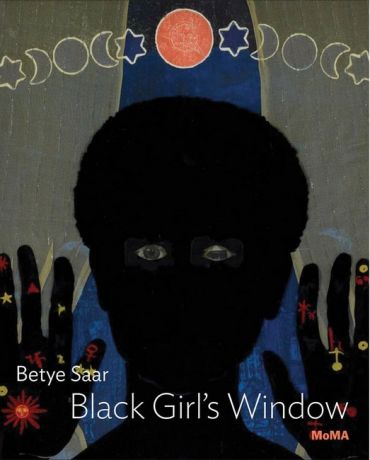
New in MoMA’s ‘One on One’ series, this book focuses on Betye Saar’s Black Girl’s Window (1969) and a selection of the artist’s prints from the 1960s and early 1970s .
Betye Saar made Black Girl’s Window in 1969. It is a deeply autobiographical picture that alluded to her African-American heritage along with her interest in mysticism and astrology. The black girl named in the title appears in the lower half of this found window frame. The girl’s facial features are hidden. The only thing there are these surprisingly bright blue eyes, which appear to open and close if you shift back and forth in front of it. The work encourages us to think about connections between eyes, that are often said to be windows on the soul, and pictures, that have been said to be windows on the world. Saar herself once said that she considers windows to represent a means of traveling from one level of consciousness to another. If you continue to look at the girl, you can see that her hands are covered with yellow and red symbols. Some of these same symbols, in particular the crescent moon and the stars, are echoed in the nine small vignettes created in the spaces outlined by the intersecting crossbars of her found window frame.
Betye Saar made Black Girl’s Window in 1969. It is a deeply autobiographical picture that alluded to her African-American heritage along with her interest in mysticism and astrology. The black girl named in the title appears in the lower half of this found window frame. The girl’s facial features are hidden. The only thing there are these surprisingly bright blue eyes, which appear to open and close if you shift back and forth in front of it. The work encourages us to think about connections between eyes, that are often said to be windows on the soul, and pictures, that have been said to be windows on the world. Saar herself once said that she considers windows to represent a means of traveling from one level of consciousness to another. If you continue to look at the girl, you can see that her hands are covered with yellow and red symbols. Some of these same symbols, in particular the crescent moon and the stars, are echoed in the nine small vignettes created in the spaces outlined by the intersecting crossbars of her found window frame.
Нова книга із серії MoMA «Один на один», присвячена роботі Бетті Саар «Вікно чорної дівчини» (1969) та добірці естампів художниці 1960-х і початку 1970-х років.
Бетті Саар створила «Вікно чорної дівчини» у 1969 році. Це глибоко автобіографічна картина, яка натякає на її афро-американське походження, а також на її інтерес до містики та астрології. Темношкіра дівчина, названа в назві картини, з'являється в нижній половині знайденої віконної рами. Риси її обличчя приховані. Єдине, що є - це напрочуд яскраві блакитні очі, які, здається, відкриваються і закриваються, якщо рухатися вперед-назад перед нею. Робота спонукає нас замислитися над зв'язком між очима, про які часто говорять, що вони є вікнами в душу, і картинами, які, як кажуть, є вікнами у світ. Сама Саар якось сказала, що вважає вікна засобом подорожі з одного рівня свідомості на інший. Якщо продовжити дивитися на дівчину, то можна побачити, що її руки вкриті жовтими та червоними символами. Деякі з цих символів, зокрема півмісяць і зірки, перегукуються з дев'ятьма маленькими віньєтками, створеними в просторі, окресленому перехрещеними перекладинами знайденої віконної рами.
- АвторChristophe Cherix
- КатегоріяХобі та захоплення
- МоваАнглійська
- Рік2019
- Сторінок48
- Формат180х230 мм
- ОбкладинкаМ'яка
- Тип паперуОфсетний
- ІлюстраціїКольорові
- СеріяMoMA One on One Series
- ЖанрБіографічна літератураКультура та мистецтвоОбразотворче мистецтво
- Вік14+
835 ₴
Відділення Нова Пошта80 ₴
Поштомат Нова Пошта80 ₴
Кур’єр Нова Пошта120 ₴
Відділення УкрПошта50 ₴
Кур’єр за адресою90 ₴










допоможіть тим, хто ще не читав