

Sebastiаo Salgado. Kuwait. A Desert on Fire 31013
Desert aflame
Sebastiao Salgado documents the torched Kuwaiti oil wells
In January and February 1991, as the United States-led coalition drove Iraqi forces out of Kuwait, Saddam Hussein’s troops retaliated with an inferno. At some 700 oil wells and an unspecified number of oil-filled low-lying areas they ignited vast, raging fires, sending billowing black clouds over the region and thousands of tons of nitrous oxide and carbon dioxide into the atmosphere.
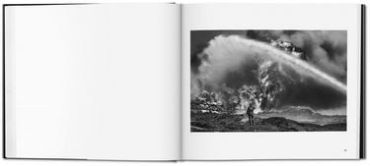
As the desperate efforts to contain and extinguish the conflagration progressed, Sebastiao Salgado traveled to Kuwait to witness the crisis firsthand. The conditions were excruciating. The heat was so vicious that Salgado’s smallest lens warped. A journalist and another photographer were killed when a slick ignited as they crossed it. Sticking close to the firefighters, and with characteristic sensitivity to both human and envrionmental impact, Salgado captured the terrifying scale of this “huge theater the size of the planet”: the ravaged landscape; the sweltering temperatures; the air choking on charred sand and soot; the blistered remains of camels; the sand still littered with cluster bombs; and the flames and smoke soaring to the skies, blocking out the sunlight, dwarfing the oil-coated firefighters.
Salgado’s epic pictures first appeared in the New York Times Magazine in June 1991 and were subsequently widely published and awarded the Oskar Barnack Award, recognizing outstanding images on the relationship between man and the environment. Kuwait: A Desert on Fire is the first monograph of this astonishing series. Like Genesis, Exodus, and The Children, it is as much a major document of modern history as an extraordinary body of photographic work.
Text in English, French, and German
Sebastiao Salgado documents the torched Kuwaiti oil wells
In January and February 1991, as the United States-led coalition drove Iraqi forces out of Kuwait, Saddam Hussein’s troops retaliated with an inferno. At some 700 oil wells and an unspecified number of oil-filled low-lying areas they ignited vast, raging fires, sending billowing black clouds over the region and thousands of tons of nitrous oxide and carbon dioxide into the atmosphere.
As the desperate efforts to contain and extinguish the conflagration progressed, Sebastiao Salgado traveled to Kuwait to witness the crisis firsthand. The conditions were excruciating. The heat was so vicious that Salgado’s smallest lens warped. A journalist and another photographer were killed when a slick ignited as they crossed it. Sticking close to the firefighters, and with characteristic sensitivity to both human and envrionmental impact, Salgado captured the terrifying scale of this “huge theater the size of the planet”: the ravaged landscape; the sweltering temperatures; the air choking on charred sand and soot; the blistered remains of camels; the sand still littered with cluster bombs; and the flames and smoke soaring to the skies, blocking out the sunlight, dwarfing the oil-coated firefighters.
Salgado’s epic pictures first appeared in the New York Times Magazine in June 1991 and were subsequently widely published and awarded the Oskar Barnack Award, recognizing outstanding images on the relationship between man and the environment. Kuwait: A Desert on Fire is the first monograph of this astonishing series. Like Genesis, Exodus, and The Children, it is as much a major document of modern history as an extraordinary body of photographic work.
Text in English, French, and German
Пустеля у вогні
Себастьян Сальгадо документує спалені кувейтські нафтові свердловини
У січні та лютому 1991 року, коли коаліція на чолі зі Сполученими Штатами витіснила іракські війська з Кувейту, війська Саддама Хусейна влаштували справжнє пекло у відповідь. Вони підпалили близько 700 нафтових свердловин і невизначену кількість заповнених нафтою низинних територій, що спричинило величезні, бурхливі пожежі, здійнявши над регіоном чорні хмари і викинувши в атмосферу тисячі тонн закису азоту і вуглекислого газу.
У той час, як відчайдушні зусилля по стримуванню і гасінню пожежі прогресували, Себастьян Сальгадо поїхав до Кувейту, щоб побачити кризу на власні очі. Умови були нестерпними. Спека була настільки нестерпною, що найменший об'єктив Сальгадо деформувався. Журналіст і ще один фотограф загинули, коли загорілася пляма, яку вони перетинали. Тримаючись поруч з пожежниками і з властивою йому чутливістю як до людського, так і до екологічного впливу, Сальгадо зафіксував жахливі масштаби цього "величезного театру розміром з планету": спустошений ландшафт, задушливі температури, повітря, що задихається від обвугленого піску і кіптяви, вкриті пухирями рештки верблюдів, пісок, все ще засмічений касетними бомбами, полум'я і дим, що здіймаються в небо, затуляючи собою сонячне світло і затуляючи собою промаслений одяг пожежників.
Епічні фотографії Сальгадо вперше з'явилися в журналі "Нью-Йорк Таймс" у червні 1991 року, а згодом були широко опубліковані і отримали премію Оскара Барнака, яка відзначає видатні зображення взаємовідносин між людиною і навколишнім середовищем. Кувейт: Пустеля у вогні" - перша монографія з цієї дивовижної серії. Як і "Буття", "Вихід" та "Діти", вона є таким же важливим документом сучасної історії, як і надзвичайною фотографічною роботою.
Текст англійською, французькою та німецькою мовами
- АвторSebastiao Salgado
- КатегоріяКультура та мистецтво
- МоваАнглійська
- Рік2016
- Сторінок206
- Формат290х320 мм
- ОбкладинкаТверда
- Тип паперуОфсетний
- ІлюстраціїКольорові
3570 ₴
Відділення Нова Пошта80 ₴
Поштомат Нова Пошта80 ₴
Кур’єр Нова Пошта120 ₴
Відділення УкрПошта50 ₴
Кур’єр за адресою90 ₴



















допоможіть тим, хто ще не читав