

Sebastiao Salgado. Genesis 31014
Earth eternal
The companion volume to the world’s best attended photo show
“In GENESIS, my camera allowed nature to speak to me. And it was my privilege to listen.” —Sebastião Salgado
On a very fortuitous day in 1970, 26-year-old Sebastião Salgado held a camera for the first time. When he looked through the viewfinder, he experienced a revelation: suddenly life made sense. From that day onward—though it took years of hard work before he had the experience to earn his living as a photographer—the camera became his tool for interacting with the world. Salgado, who “always preferred the chiaroscuro palette of black-and-white images,” shot very little color in his early career before giving it up completely.
Raised on a farm in Brazil, Salgado possessed a deep love and respect for nature; he was also particularly sensitive to the ways in which human beings are affected by their often devastating socio-economic conditions. Of the myriad works Salgado has produced in his acclaimed career, three long-term projects stand out: Workers (1993), documenting the vanishing way of life of manual laborers across the world, Migrations (2000), a tribute to mass migration driven by hunger, natural disasters, environmental degradation and demographic pressure, and this new opus, GENESIS, the result of an epic eight-year expedition to rediscover the mountains, deserts and oceans, the animals and peoples that have so far escaped the imprint of modern society—the land and life of a still-pristine planet. “Some 46% of the planet is still as it was in the time of genesis,” Salgado reminds us. “We must preserve what exists.” The GENESIS project, along with the Salgados’ Instituto Terra, are dedicated to showing the beauty of our planet, reversing the damage done to it, and preserving it for the future.
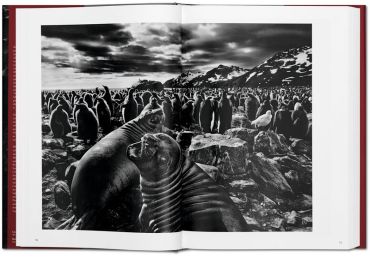
Over 30 trips—travelled by foot, light aircraft, seagoing vessels, canoes, and even balloons, through extreme heat and cold and in sometimes dangerous conditions—Salgado created a collection of images showing us nature, animals, and indigenous peoples in breathtaking beauty. Mastering the monochrome with an extreme deftness to rival the virtuoso Ansel Adams, Salgado brings black-and-white photography to a new dimension; the tonal variations in his works, the contrasts of light and dark, recall the works of Old Masters such as Rembrandt and Georges de La Tour.
What does one discover in GENESIS? The animal species and volcanoes of the Galápagos; penguins, sea lions, cormorants, and whales of the Antarctic and South Atlantic; Brazilian alligators and jaguars; African lions, leopards, and elephants; the isolated Zo’é tribe deep in the Amazon jungle; the Stone Age Korowai people of West Papua; nomadic Dinka cattle farmers in Sudan; Nenet nomads and their reindeer herds in the Arctic Circle; Mentawai jungle communities on islands west of Sumatra; the icebergs of the Antarctic; the volcanoes of Central Africa and the Kamchatka Peninsula; Saharan deserts; the Negro and Juruá rivers in the Amazon; the ravines of the Grand Canyon; the glaciers of Alaska... and beyond. Having dedicated so much time, energy, and passion to the making of this work, Salgado likens GENESIS to “my love letter to the planet.”
Whereas the limited Collector’s Edition is conceived like a large-format portfolio that meanders across the planet, this unlimited book presents a selection of photographs arranged in five chapters geographically: Planet South, Sanctuaries, Africa, Northern Spaces, Amazonia and Pantanal. Each in its own way, this book and the Collector’s edition—both edited and designed by Lélia Wanick Salgado—pay homage to Salgado’s triumphant and unparalleled GENESIS project.
The companion volume to the world’s best attended photo show
“In GENESIS, my camera allowed nature to speak to me. And it was my privilege to listen.” —Sebastião Salgado
On a very fortuitous day in 1970, 26-year-old Sebastião Salgado held a camera for the first time. When he looked through the viewfinder, he experienced a revelation: suddenly life made sense. From that day onward—though it took years of hard work before he had the experience to earn his living as a photographer—the camera became his tool for interacting with the world. Salgado, who “always preferred the chiaroscuro palette of black-and-white images,” shot very little color in his early career before giving it up completely.
Raised on a farm in Brazil, Salgado possessed a deep love and respect for nature; he was also particularly sensitive to the ways in which human beings are affected by their often devastating socio-economic conditions. Of the myriad works Salgado has produced in his acclaimed career, three long-term projects stand out: Workers (1993), documenting the vanishing way of life of manual laborers across the world, Migrations (2000), a tribute to mass migration driven by hunger, natural disasters, environmental degradation and demographic pressure, and this new opus, GENESIS, the result of an epic eight-year expedition to rediscover the mountains, deserts and oceans, the animals and peoples that have so far escaped the imprint of modern society—the land and life of a still-pristine planet. “Some 46% of the planet is still as it was in the time of genesis,” Salgado reminds us. “We must preserve what exists.” The GENESIS project, along with the Salgados’ Instituto Terra, are dedicated to showing the beauty of our planet, reversing the damage done to it, and preserving it for the future.
Over 30 trips—travelled by foot, light aircraft, seagoing vessels, canoes, and even balloons, through extreme heat and cold and in sometimes dangerous conditions—Salgado created a collection of images showing us nature, animals, and indigenous peoples in breathtaking beauty. Mastering the monochrome with an extreme deftness to rival the virtuoso Ansel Adams, Salgado brings black-and-white photography to a new dimension; the tonal variations in his works, the contrasts of light and dark, recall the works of Old Masters such as Rembrandt and Georges de La Tour.
What does one discover in GENESIS? The animal species and volcanoes of the Galápagos; penguins, sea lions, cormorants, and whales of the Antarctic and South Atlantic; Brazilian alligators and jaguars; African lions, leopards, and elephants; the isolated Zo’é tribe deep in the Amazon jungle; the Stone Age Korowai people of West Papua; nomadic Dinka cattle farmers in Sudan; Nenet nomads and their reindeer herds in the Arctic Circle; Mentawai jungle communities on islands west of Sumatra; the icebergs of the Antarctic; the volcanoes of Central Africa and the Kamchatka Peninsula; Saharan deserts; the Negro and Juruá rivers in the Amazon; the ravines of the Grand Canyon; the glaciers of Alaska... and beyond. Having dedicated so much time, energy, and passion to the making of this work, Salgado likens GENESIS to “my love letter to the planet.”
Whereas the limited Collector’s Edition is conceived like a large-format portfolio that meanders across the planet, this unlimited book presents a selection of photographs arranged in five chapters geographically: Planet South, Sanctuaries, Africa, Northern Spaces, Amazonia and Pantanal. Each in its own way, this book and the Collector’s edition—both edited and designed by Lélia Wanick Salgado—pay homage to Salgado’s triumphant and unparalleled GENESIS project.
Земля вічна
Супровідний том до найвідвідуванішої фотовиставки у світі
"У GENESIS моя камера дозволила природі говорити зі мною. І це був мій привілей - слухати". -Себастьян Сальгадо
У дуже щасливий день 1970 року 26-річний Себастьян Сальгадо вперше взяв до рук фотоапарат. Коли він подивився у видошукач, то пережив одкровення: раптом життя набуло сенсу. Відтоді - хоча минули роки наполегливої праці, перш ніж він набув досвіду, щоб заробляти на життя як фотограф, - фотоапарат став його інструментом взаємодії зі світом. Сальгадо, який "завжди віддавав перевагу палітрі світлотіні чорно-білих зображень", на початку своєї кар'єри знімав дуже мало кольору, перш ніж повністю відмовитися від нього.
Сальгадо виріс на фермі в Бразилії, він глибоко любив і поважав природу; він також був особливо чутливим до того, як на людей впливають їхні часто руйнівні соціально-економічні умови. Серед безлічі робіт, які Сальгадо створив за свою визнану кар'єру, виділяються три довготривалі проекти: "Робітники" (1993), що документує зникаючий спосіб життя працівників фізичної праці по всьому світу, "Міграції" (2000), данина масовим міграціям, спричиненим голодом, стихійними лихами, деградацією довкілля та демографічним тиском, і цей новий опус, "ГЕНЕЗИС", результат епічної восьмирічної експедиції, що мала на меті заново відкрити для себе гори, пустелі й океани, тварин і народи, які досі не зазнали впливу сучасного суспільства, - землю і життя досі незайманої планети. "Близько 46% планети все ще залишається такою, якою вона була в часи генезису, - нагадує Сальґадо. "Ми повинні зберегти те, що існує". Проект GENESIS разом з Інститутом Terra Сальгадо присвячені показу краси нашої планети, виправленню завданої їй шкоди та збереженню її для майбутнього.
Понад 30 подорожей - пішки, на легких літаках, морських суднах, каное і навіть повітряних кулях, в екстремальну спеку і холод, а іноді і в небезпечних умовах - Сальгадо створив колекцію зображень, що демонструють нам природу, тварин і корінні народи в красі, від якої перехоплює подих. Опановуючи монохром з надзвичайною вправністю, яка не поступається віртуозному Анселю Адамсу, Сальгадо виводить чорно-білу фотографію в новий вимір; тональні варіації в його роботах, контрасти світла і темряви нагадують роботи старих майстрів, таких як Рембрандт і Жорж де Ла Тур.
Що ми відкриваємо для себе в GENESIS? Види тварин і вулкани Галапагоських островів; пінгвінів, морських левів, бакланів і китів Антарктики та Південної Атлантики; бразильських алігаторів і ягуарів; африканських левів, леопардів і слонів; ізольоване плем'я зое глибоко в джунглях Амазонки; народ короваї кам'яного віку із Західного Папуа; кочових скотарів дінка в Судані; кочівники ненці та їхні оленячі стада за Полярним колом; громади джунглів Ментавай на островах на захід від Суматри; айсберги Антарктики; вулкани Центральної Африки та півострова Камчатка; пустелі Сахари; річки Негро та Журуа в Амазонії; яри Великого каньйону; льодовики Аляски. .. і не тільки. Присвятивши стільки часу, енергії та пристрасті створенню цієї роботи, Сальгадо порівнює GENESIS з "моїм любовним листом до планети".
Тоді як лімітоване колекційне видання задумане як широкоформатне портфоліо, що мандрує планетою, ця необмежена книга представляє добірку фотографій, розташованих у п'яти розділах за географічним принципом: "Планета Південь", "Заповідники", "Африка", "Північні простори", "Амазонія" та "Пантанал". Ця книга та колекційне видання, упорядковане та оформлене Лелією Ванік Сальґадо, - кожна по-своєму - віддають шану тріумфальному та безпрецедентному проекту Сальґадо "ҐЕНЕЗИС".
- АвторLelia Wanick Salgado
- КатегоріяКультура та мистецтво
- МоваАнглійська
- Рік2017
- Сторінок520
- Формат250х360 мм
- ОбкладинкаТверда
- Тип паперуКрейдований
- ІлюстраціїЧорно-білі
4760 ₴
Відділення Нова Пошта80 ₴
Поштомат Нова Пошта80 ₴
Кур’єр Нова Пошта120 ₴
Відділення УкрПошта50 ₴
Кур’єр за адресою90 ₴

















допоможіть тим, хто ще не читав